Part II Summary
Using CQI in comprehensive PHC
Part II has described how CQI can be used in a comprehensive approach to PHC. We have discussed how evidence is used to guide clinical practice, sources of data for CQI, and the principles that guide decisions about generating information to measure care quality. Principles and features of CQI facilitation have been described, supported with examples from PHC settings. Tools and techniques for facilitating CQI cycles in PHC have been included, along with some useful types of graphs for presenting CQI data. We have discussed variation in quality and introduced a CQI cycle that acknowledges the complexity of improving comprehensive PHC. Finally, we have discussed the importance of organisational culture for embedding and sustaining CQI.
Figure II.1 brings this information together to align the tools, techniques and types of graphs with the phases of the CQI cycle. Note that several tools, techniques and graphs are suited to more than one stage.
Whatever CQI tools and techniques you use, participatory approaches, facilitation and ongoing commitment to improving the quality of care are keys to success. CQI efforts need to be sustained to make a positive difference for PHC clients and populations. Changes need to be grounded in an organisational culture that actively supports CQI.
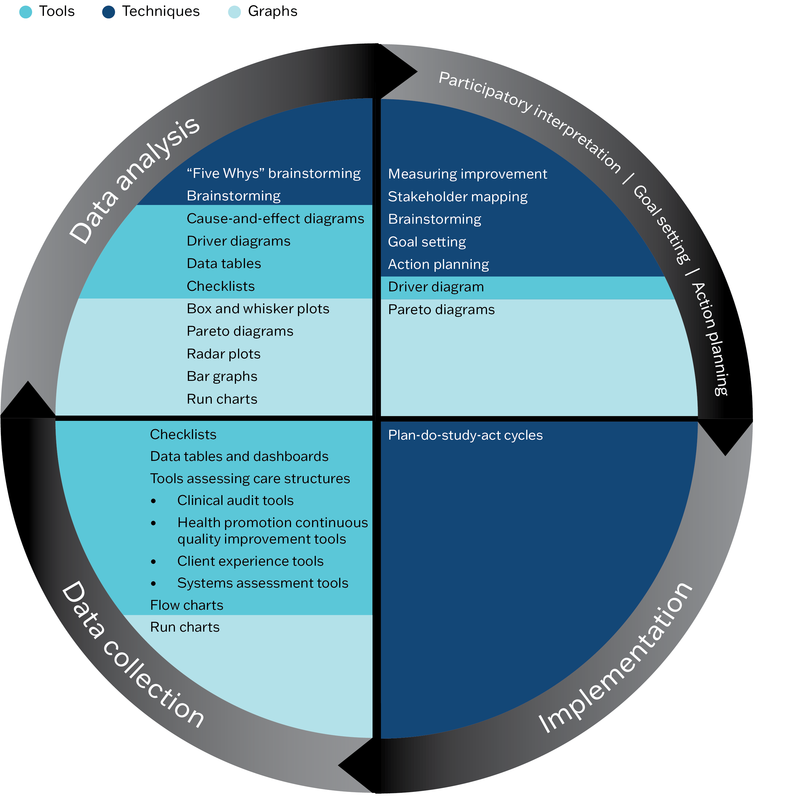
Figure II.1 Use of CQI tools, techniques, and types of graphs in a CQI cycle.
Further resources
Downloadable templates and instructions for the selected tools, and for other CQI tools, are available on the following websites.
Agency for Healthcare Research and Quality
Clinical Excellence Commission, Quality Improvement Academy
Institute for Healthcare Improvement’s “Quality Improvement Essentials Toolkit”
National Health Service Improvement Hub
Menzies School of Health Research
University Centre for Rural Health
Quality improvement toolkits have been developed for specific countries and/or health issues. An example is the National HIV service quality improvement tool kit developed by the Federal Ministry of Health of Ethiopia and published by the World Health Organization (2018). Access the toolkit.
The World Health Organization has collated tools to support the integration of stakeholder
and community engagement in quality-of-care initiatives for maternal, newborn, child and
adolescent health. Access the online resources.
We encourage you to search for resources and examples that are relevant to the continuous
quality improvement needs of your primary healthcare team, practice or service – and to
regularly update your search.